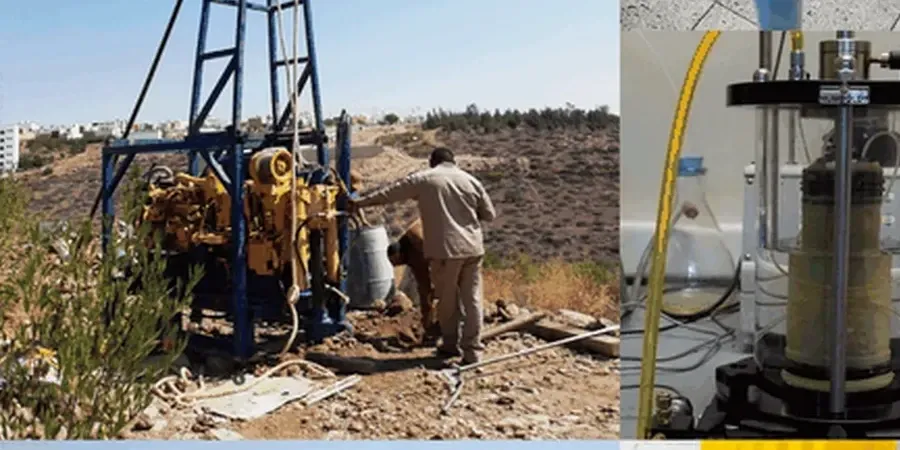
Bangor sits at the base of the Menai Strait, where the landscape shifts from the steep Cambrian gritstone of Snowdonia to the softer glacial deposits along the coast. A soil mechanics study here has to account for that sharp geological contrast. The city’s Victorian terraces on Garth Road and the newer developments near Parc Bryn Cegin both sit on material that can change within metres. The Gwynedd County Council planning process requires a factual ground investigation report, and that starts with a solid laboratory programme. We run the full suite of BS 5930 tests—triaxial, oedometer, direct shear—to give you the effective stress parameters your structural engineer needs. Combined with in-situ data from a CPT test, the lab results build a model of the ground that holds up under scrutiny from Building Control, with every sample handled at our UKAS-accredited facility.
In Bangor’s glacial terrain, effective stress parameters from triaxial and direct shear are the difference between a safe foundation and an expensive surprise.
Method and coverage
In Bangor, we frequently see a thin layer of soft alluvial clay overlying dense glacial till, which creates a classic bearing capacity puzzle. The lab programme separates these layers: we determine the undrained shear strength of the clay via triaxial and the drained friction angle of the till via direct shear, so the foundation design isn’t averaging two very different materials. Particle size distribution and Atterberg limits give us the classification to BS EN ISO 14688, and the consolidation test tells you how much settlement to expect under the working load. We also run chemical testing for sulfates and pH on the soil and groundwater—critical in Bangor where old marine deposits can leave aggressive ground conditions. Every report includes a clear set of derived values: c’, φ’, mv, and a recommended bearing stratum depth, ready to drop into your Eurocode 7 design.
Q&A
What does a soil mechanics study in Bangor typically cost?
For a residential or small commercial project in Bangor, a soil mechanics study with triaxial, oedometer, classification, and chemical tests usually falls between £2,440 and £3,710. The final figure depends on the number of samples and the specific test programme agreed with the structural engineer.
How long does the lab testing take?
Standard classification and shear strength tests take 7–10 working days from sample receipt. Consolidation tests add 5–7 days due to the incremental loading schedule. We can fast-track the triaxial programme if your contractor is waiting to order steel.
Do you test for aggressive ground conditions?
Yes, every Bangor project includes a BRE SD1 suite: water-soluble sulfate, magnesium, pH, and total potential sulfate. Given the marine origin of the local clays, this is not optional—it determines the design chemical class for the buried concrete.