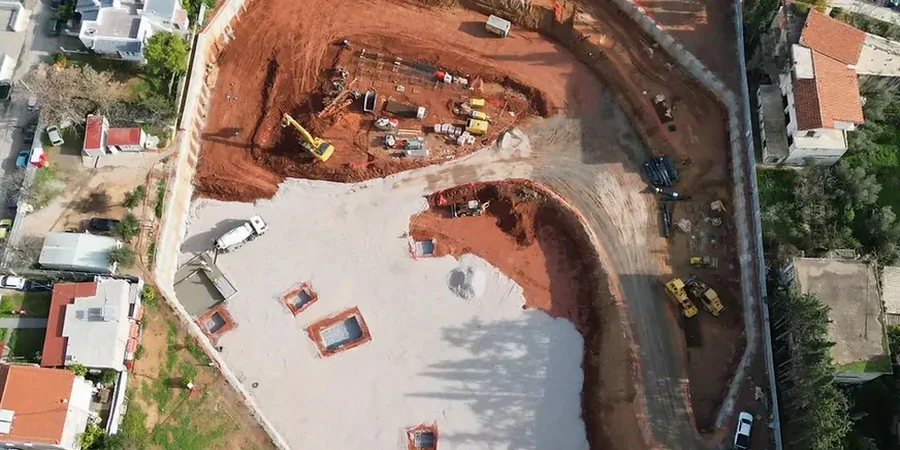
We have seen too many contractors in Bangor start a major excavation with nothing more than a desktop study and a prayer. This is not London clay. The ground here shifts from glacial till to Cambrian mudstone in the space of 50 metres, and what looks like a competent rock face can hide water-bearing fissures that turn a 4-metre cut into a major stability problem overnight. Designing a deep excavation without a proper ground model is the fastest way to blow a 30% contingency before you have even placed the first strut. Before you commit plant to site, we recommend pairing your ground investigation with a CPT test to map the soft alluvial pockets that plague the Menai Strait lowlands, and reviewing how the temporary works will interact with the permanent retaining walls — because in Bangor, the two are rarely independent.
A 6-metre excavation in Bangor's glacial till costs roughly the same to support correctly as it does to remediate after a failure — but only one of those comes with a programme delay and a Form 10 notification to the HSE.
Regional considerations
The Ordovician and Cambrian bedrock that outcrops across Bangor Mountain and the city centre is heavily jointed and can contain high-pressure artesian water in confined fissures, a condition that has caused sudden base heave in at least two recorded construction incidents in North Wales over the past decade. In the lower-lying areas near the pier and Hirael, the superficial deposits consist of soft estuarine silts with an undrained shear strength below 20 kPa, which is barely enough to stand unsupported for a 1.2-metre trench. Designing a deep excavation here without probing for these transitions is asking for trouble. Even a small blow-in at the toe of a sheet pile wall can cause rapid loss of passive resistance, followed by structural collapse of the walings and struts. We design against these scenarios using a revised partial factor approach that accounts for the spatial variability of the ground, not a single conservative value that hides the real risk.
Q&A
How much does a deep excavation design for a single basement in Bangor typically cost?
For a standard residential or commercial basement excavation in Bangor with a single-level propped wall and a depth of 3.5 to 5.5 metres, the design fee typically falls between £1,830 and £5,650. The final cost depends on the number of support levels, the complexity of the groundwater control system, and whether you need a full 3D analysis for a corner or irregular footprint. This includes the design calculation package, construction sequence drawings, and a monitoring specification — everything your temporary works supervisor needs for the client and the principal designer under CDM 2015.
What is the difference between DA1 and DA2 in Eurocode 7 for excavation design?
DA1 (Design Approach 1) requires two separate combinations of partial factors — Combination 1 (A1+M1+R1) and Combination 2 (A2+M2+R1) — and you must satisfy both. DA2 (Design Approach 2) uses a single combination (A1+M1+R2). In UK practice, DA1 is the default for deep excavations because it typically governs the structural design of the wall section (Combination 1) and the geotechnical stability of the base and passive zone (Combination 2). We apply DA1 as standard for all Bangor projects unless the client's internal standards explicitly request DA2.
How long does the design process take from instruction to issue of the final package?
For a typical Bangor basement excavation with a single-level propped wall, you can expect a Stage 1 draft within 8 to 10 working days of receiving a complete ground investigation report. The final design package, including any client or checking-engineer review cycles, is usually issued within 15 to 18 working days. Larger infrastructure cuts or multi-level anchor designs require 20 to 25 working days. We run an accelerated 5-day service for urgent projects where the enabling works programme cannot wait, though this requires the ground investigation data to be fully complete at the start.