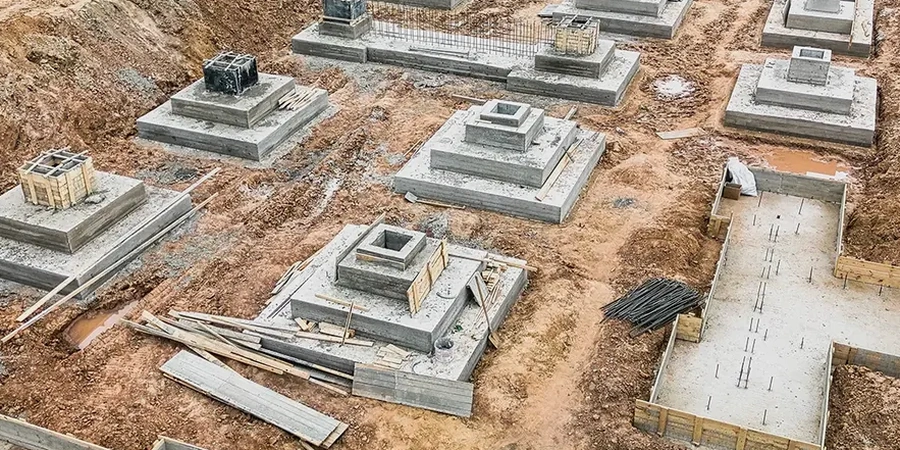
When you first break ground in Bangor, the transition from the coastal plain to the steep slopes of Snowdonia's foothills reveals a subsurface profile that rarely matches expectations. We regularly encounter dense glacial tills overlying the Ordovician mudstone and slate bedrock, often with a weathered transition zone that complicates load transfer predictions. A desk study alone will not tell you whether driven piles will refuse early on shallow rock or whether CFA rigs can penetrate the boulder clays left behind by the Menai Strait glaciation. Our approach combines site-specific ground investigation with CPT testing where access permits, giving us a continuous resistance profile through the till before we commit to a pile type. For sites near the university or along the A5 corridor, we also integrate seismic refraction data to map the rockhead gradient, which in Bangor can vary by several metres across a single building footprint.
Bangor's glacial till demands pile design parameters calibrated to local load tests, not generic textbook values—the difference can be a factor of two in shaft resistance.
Method and coverage
A mistake we see too often in North Wales is specifying driven H-piles without checking for the metasedimentary boulders that litter the glacial till—leading to buckling, refusal, and costly redesign mid-contract. Our pile foundation design process starts with a thorough parameterisation of the ground model under BS EN 1997-1:2004, using characteristic values derived from in-situ tests rather than conservative textbook correlations. We model the shaft resistance in glacial lodgement till using effective stress parameters calibrated against local load test data, which consistently shows beta values higher than those assumed in the standard guidance. For the weathered slate bedrock that underlies much of Bangor, end-bearing capacity is verified against unconfined compressive strength tests on recovered core, with socket lengths adjusted to account for the anisotropic strength of the highly cleaved rock. Every design includes a constructability review—because a pile that works on paper but cannot be installed through a metre of cobbles is simply a liability.
Regional considerations
The Menai Strait climate imposes a wet, temperate regime with over 1,000 mm of annual rainfall and persistent groundwater perched within the superficial deposits. This saturation reduces effective stress in the upper till layers and can trigger softening of the weathered mudstone if excavations are left open, even for a day. Pile designs in Bangor must account for negative skin friction where fill has been placed over compressible alluvium—a scenario we encounter frequently on brownfield sites near the waterfront. The seismic hazard in North Wales is low but not negligible; we assess the need for kinematic pile-soil interaction analysis on a project-specific basis, particularly where liquefiable silt lenses are identified within the glacial sequence. Underestimating the variability of the rockhead is the single biggest risk we see, and it is one that can only be managed through an adequately dense investigation, not by extrapolating from two boreholes across a 50-metre site.
Q&A
How much does a pile foundation design cost for a project in Bangor?
For a typical residential or light commercial project in the Bangor area, pile foundation design fees range from £1,440 to £4,470, depending on the complexity of the ground conditions, the number of piles, and whether load testing is included. A straightforward scheme on competent till with a few CFA piles will sit at the lower end; a more involved design on variable rockhead with load tests and detailed settlement analysis moves towards the upper end.
Which pile types work best in Bangor's glacial till?
Continuous flight auger (CFA) piles generally perform well in the lodgement till, provided the rig has sufficient torque to penetrate occasional cobbles. Where boulders are abundant or rockhead is shallow, driven H-piles with a rock shoe or bored piles with temporary casing through the till into bedrock are more reliable. We select the pile type based on the specific ground investigation data for each site.
Do you handle the full Eurocode 7 design, including the Geotechnical Design Report?
Yes, every pile design we deliver includes a Geotechnical Design Report (GDR) compliant with BS EN 1997-1 and the UK National Annex. The GDR covers the ground model, derivation of characteristic values, ULS and SLS calculations for all relevant limit states, and the supervision and monitoring requirements during construction.
What level of ground investigation do you need before starting pile design?
We require a ground investigation that meets BS 5930:2015+A1:2020 standards for the proposed structure's Geotechnical Category, typically including boreholes or CPTs to at least 5 metres below the anticipated pile toe level. For Bangor sites, this almost always means penetrating the full thickness of the glacial till and at least 3 metres into competent bedrock to confirm the socket depth and end-bearing capacity.