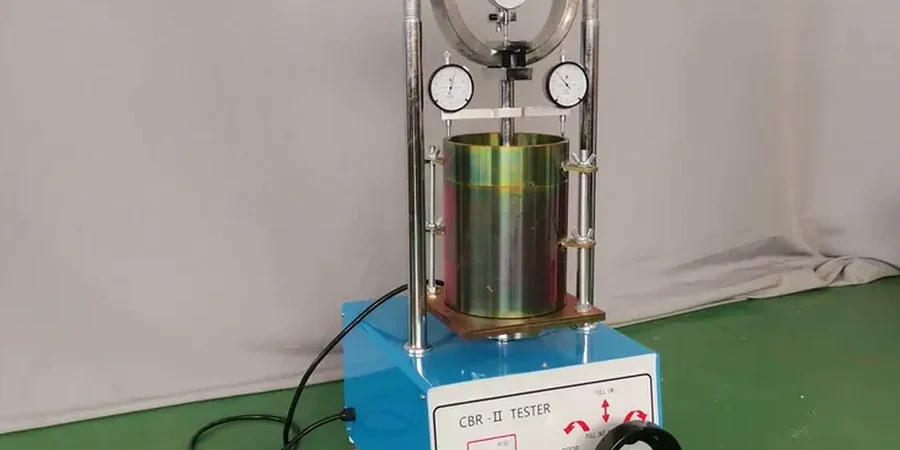
With over 18,000 residents and sitting between the Menai Strait and the foothills of Eryri, Bangor's infrastructure has to handle everything from saturated glacial till to well-drained weathered rock. Road failures here rarely come from traffic alone—more often, the culprit is a subgrade that softens after a wet winter. The CBR test for road design provides a direct measurement of that bearing capacity, so the pavement thickness isn't just a guess. Our laboratory CBR test runs on specimens compacted to the density and moisture condition you specify, giving you a California Bearing Ratio value that feeds straight into the design catalogues in HD 26/06. For projects where the formation level varies significantly, we often pair soaked CBR with in-situ permeability tests to understand how quickly water moves through the formation.
A soaked CBR value below 2.5% almost always triggers capping or stabilisation—ignoring it is how you get longitudinal cracking in the first winter.
Method and coverage
Bangor's Victorian expansion up the slope from the cathedral towards Upper Bangor left a legacy of made ground, buried stream channels, and highly variable drift deposits. That patchwork means two boreholes 50 metres apart can yield completely different CBR values—one pushing 15% in dense till, another dropping to 2% in softened glaciolacustrine clay. The laboratory CBR test lets you evaluate each layer under controlled conditions, without weather messing up the reading. We prepare remoulded or undisturbed specimens at target moisture contents, apply a 4-day soak to simulate the worst-case saturated state, then measure penetration resistance with a standard plunger at 1.27 mm per minute. The force-penetration curve is corrected for surface irregularities, and the reported value is the higher of the readings at 2.5 mm and 5.0 mm penetration, expressed as a percentage of the standard crushed stone reference. For designers working on link roads or estate access, this number determines whether you need 150 mm of capping or a full 600 mm sub-base replacement.
Regional considerations
A common mistake we see in Bangor is using a single CBR value from one trial pit and applying it across the whole site—especially where the A5 corridor cuts through terraced ground with fill of unknown provenance. The equilibrium moisture content in those fills can shift by 3-4% between summer and winter, knocking the CBR down by half. Running three to five laboratory CBR tests across different material zones gives you a range rather than a single number, and that range lets the pavement engineer decide whether to design for the median, the lower quartile, or the minimum. Without that spread, the risk isn't theoretical: it shows up as rutting in the wheel paths, edge break-up where drainage is poor, and a maintenance liability that the adopting authority may refuse to take on.
Q&A
How much does a laboratory CBR test cost in Bangor?
A single-point soaked CBR test typically falls between £110 and £160 per specimen, depending on whether it is remoulded or undisturbed and how many moisture points you need. A full suite of three specimens for a pavement design package is more cost-effective per point. We quote fixed prices before starting so there are no surprises.
Which standard do you follow for CBR testing in the UK?
We follow BS 1377-4:1990 for natural soils and BS EN 13286-47 for unbound mixtures. The soaked procedure runs for 96 hours under surcharge weights, and we report the corrected CBR at both 2.5 mm and 5.0 mm penetration, taking the higher value as the design CBR.
Do I need a soaked or unsoaked CBR for a pavement design in North Wales?
For almost every pavement in Bangor, the adopting authority will expect a soaked CBR value. The 4-day soak simulates long-term saturation of the subgrade after construction, which is the critical condition in a climate where annual rainfall exceeds 1,000 mm. Unsoaked testing can supplement the soaked programme to assess sensitivity, but the design value is nearly always soaked.
How many CBR specimens should I test for a residential access road?
For a typical residential access road of 100 to 200 metres in Bangor, we recommend a minimum of three laboratory CBR specimens taken from different material zones identified in the trial pits. If the ground investigation shows variable fill or glacial deposits, five specimens give a much more reliable statistical spread for pavement design.
What happens if my CBR value comes back below 2%?
A soaked CBR below 2% means the material is effectively unsuitable as a subgrade without treatment. The standard solution is to excavate and replace with a capping layer, stabilise the material with lime or cement, or design a thicker pavement structure with a geogrid-reinforced sub-base. We can advise on the most practical option for your specific formation conditions.