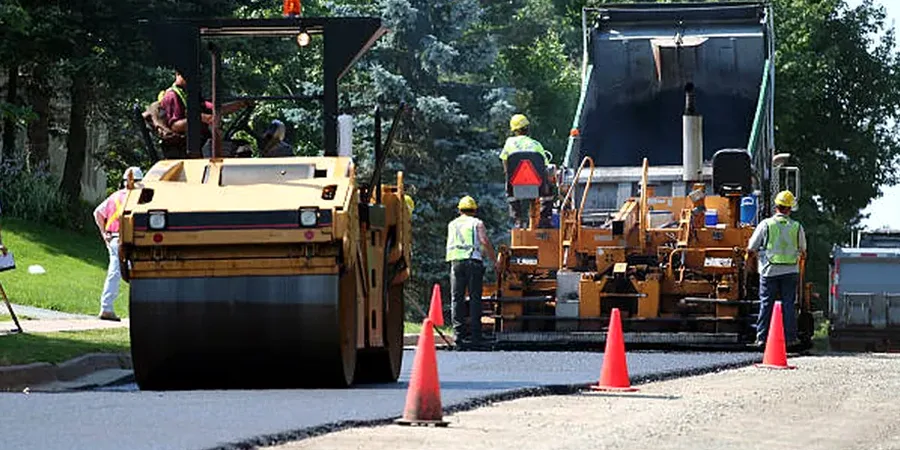
Road design in Bangor demands a clear understanding of what lies beneath the surface. The city sits on a complex mix of glacial till, alluvial deposits, and weathered Ordovician rock that can change drastically within a few hundred metres. BS 5930 and the DMRB CD 225 provide the framework, but applying them correctly means knowing the local ground. Our lab runs routine CBR tests, moisture condition assessments, and triaxial work under BS 1377 to feed directly into pavement thickness calculations. We also pull in data from test pits when site access allows, or from CPT testing on larger schemes where continuous profiling speeds up the investigation. The goal is always the same: a pavement that handles North Wales weather and traffic without premature rutting or cracking.
A pavement design is only as good as the CBR value it rests on—and in Bangor, that value changes block by block.
Regional considerations
Bangor expanded in bursts—the Victorian terrace belts, the mid-20th-century estates, and the more recent retail parks along Caernarfon Road. Each phase left its own legacy of fill and disturbed ground. The biggest risk we see on road jobs here is undocumented made ground: old basements backfilled with rubble, ash, and god knows what. It compacts unevenly, rots, or holds water, creating soft spots that punch through a new pavement within two winters. A desk study and a few window samples are not enough. We push for targeted test pits at low points and boundary areas. On the A5 corridor, traffic loading is heavy and relentless; a failed subgrade patch means lane closures and political headaches. Getting the CBR profile right from the start is cheaper than digging out a collapsed road later.
Q&A
What CBR value do we need for a residential road in Bangor?
For a typical residential access road with light traffic, a soaked CBR of 3 to 5% at formation level is usually the minimum target. If the natural ground gives less than 2.5%, you will almost certainly need a capping layer or lime stabilisation to reach a workable platform. We test at the expected formation depth and advise on the most cost-effective option.
How much does a pavement design investigation cost in Bangor?
For a standard flexible pavement investigation covering CBR, classification tests, and a factual report, budgets typically fall between £1,220 and £4,180 depending on the number of exploratory holes and the lab schedule. A small car park might sit at the lower end; a new estate road with several boreholes and full capping assessment moves towards the upper range.
Do you test for frost susceptibility?
Yes. Frost heave is relevant in North Wales, especially on exposed sites above Bangor towards the mountains. We determine frost susceptibility class by measuring the proportion of fines and using the criteria in DMRB CD 225 and the old HA 25/94 guidance where applicable.
Can you test the existing pavement before an overlay?
Absolutely. We core the existing asphalt, log the layer thicknesses, and take samples of the foundation. This lets us back-calculate the effective CBR and check whether the old pavement is contributing structurally or just adding dead weight. It often saves importing expensive new granular material.