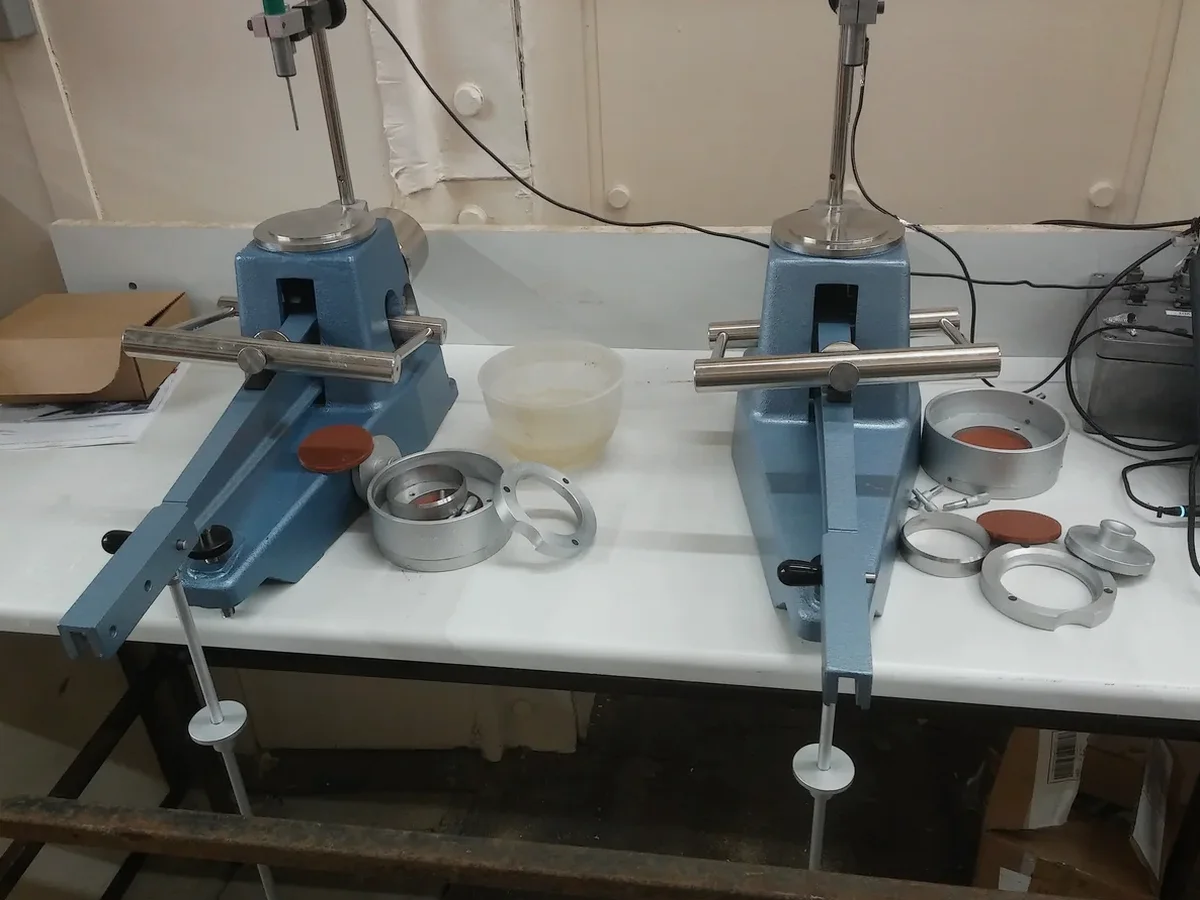
Bangor’s population of roughly 16,000 might suggest a quiet town, but the geology here keeps things interesting. The city straddles an area where glacial till, alluvial deposits, and the underlying Ordovician mudstones all compete for space, creating a complex subsurface profile that changes drastically from the Menai Strait waterfront up to the higher ground near the university. For any earthworks or foundation design, classifying these soils correctly determines whether your project moves forward or stalls. Our Atterberg limits testing service quantifies the liquid limit, plastic limit, and plasticity index of these local cohesive soils, giving you the hard numbers needed to predict volume change potential and shear strength. We run these tests in accordance with BS EN ISO 17892-12:2018, ensuring the data feeds directly into your geotechnical design. Many projects in Bangor benefit from pairing this analysis with a detailed grain size distribution to fully characterise the fine fraction of the glacial till that blankets much of the city.
A plasticity index above 20% in the glacial till of Bangor signals a high-volume change potential that can compromise shallow foundations if ignored.
Regional considerations
The glacial till covering much of Bangor contains lenses of laminated clay that can be deceptively stable during a dry summer but turn plastic and mobile after the heavy autumn rains that sweep in from the Irish Sea. Annual precipitation in the city exceeds 1,000 mm, a factor that keeps the natural water content of near-surface soils high for much of the year. If site investigation skips the Atterberg limits, the design team operates without a true picture of how the ground will respond to seasonal moisture cycles. This creates a real risk of differential settlement in foundations or pavement layers, particularly on sloping sites above the Menai Strait where lateral movement adds another dimension to the problem. We have consulted on projects in Bangor where ignoring the plasticity characteristics of the boulder clay led to costly remedial work after the first winter. A small investment in index testing during the ground investigation phase provides the data to specify appropriate foundation depths, select fill materials with compatible plasticity, and design effective drainage that keeps the subgrade moisture content stable throughout the structure's service life.
Q&A
What do Atterberg limits actually measure in a Bangor soil sample?
Atterberg limits define the water content boundaries between different consistency states of a fine-grained soil. The liquid limit marks the transition from liquid to plastic behaviour, the plastic limit marks the change from plastic to semi-solid, and the plasticity index is the numerical difference between them. For the glacial tills and alluvial clays common in Bangor, these values tell us how much water the soil can absorb before losing strength, which is critical for assessing the stability of foundations, slopes, and earthworks during the wet Welsh winters.
How much does Atterberg limits testing cost for a project in Bangor?
For a standard set of Atterberg limits on a single disturbed sample, the cost typically falls in the range of £40 to £70, depending on the number of samples and whether you need a rush turnaround. Bundling several index tests together usually reduces the per-sample rate, so it is worth discussing your full investigation programme with the laboratory to get the best value.
How long does it take to get results back from the lab?
Our standard turnaround for Atterberg limits testing is three to five working days from the moment the sample arrives at the laboratory. If your ground investigation in Bangor is on a tight schedule, we can often arrange a faster service for an additional fee. The time needed depends on the natural moisture content of the soil and the number of repeat determinations required to meet the precision standards in BS EN ISO 17892-12.
What type of soil sample do you need for the test?
We need a disturbed sample of at least 200 grams of the cohesive soil, taken from the fine fraction that passes a 425-micron sieve. The sample can come from a trial pit, a window sampler, or a borehole in Bangor. It does not need to be undisturbed like a triaxial sample, but it should be sealed in a plastic bag immediately after extraction to prevent moisture loss, because the natural water content is part of the full plasticity assessment.