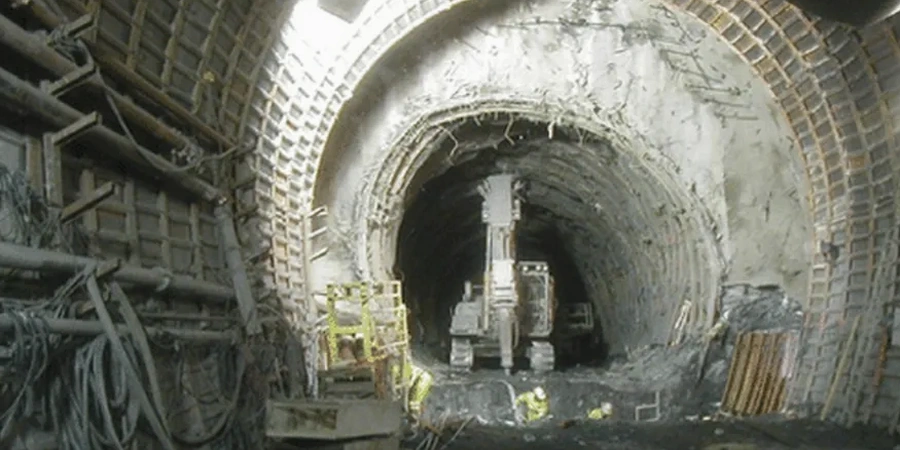
The geotechnical landscape around Bangor is shaped by the legacy of the last ice age. Glacial till, laminated silts, and pockets of soft alluvium nestled along the Menai Strait create a subsurface that challenges even the most experienced tunnelling teams. We have seen projects stall because someone assumed uniform bedrock conditions, only to hit saturated fines at invert level. Our approach combines targeted In-Situ with laboratory classification to map the transition zones between dense moraine and the softer deposits that dominate the low-lying areas. A cone penetration test provides a continuous profile through these variable strata, and pairing it with a triaxial assessment helps define the effective stress parameters needed for a reliable finite element model.
You do not design a tunnel in the Menai region based on a single borehole log; you design it based on the pore pressure profile and the soil's stress history.
Regional considerations
In Bangor, the most common tunnel risk we observe is not the soft soil itself, but the groundwater regime trapped within it. Lenses of sand and silt within the glacial sequence can hold artesian pressures that release suddenly at the face, turning a stable heading into a flowing mess within minutes. We also deal with the proximity of historic structures built on shallow footings, where even minimal settlement from tunnelling can trigger claims. Our team focuses on characterising the undrained shear strength profile using field vane and CPT data, then cross-referencing with BS EN 1997-1 Design Approach 1 to check face stability. When the risk of chimney collapse through the overburden is present, we specify sequential excavation sequences with advance probing, a method we have refined on several crossing projects beneath the city's Victorian infrastructure.
Q&A
Is a full ground investigation mandatory for a small diameter tunnel in Bangor?
Yes, even a microtunnel beneath Bangor's streets requires a ground investigation compliant with BS 5930. The transition between the glacial till and the underlying mudstone is often erratic, and a single borehole can miss a soft clay lens that would cause the TBM to lose face control.
What does a soft ground tunnel analysis typically cost in Bangor?
The fee for a comprehensive tunnel feasibility study in Bangor, including site investigation, laboratory testing, and numerical modelling, ranges from £3,500 to £13,150. The final figure depends on the tunnel depth, the number of investigation points, and the complexity of the groundwater regime.
How do you determine the stand-up time for a tunnel face in soft soil?
We calculate the stand-up time based on the undrained shear strength and the overburden pressure, using the Broms and Bennermark stability number. For Bangor's sensitive silts, we also factor in the liquidity index and the soil's sensitivity, as remoulding during excavation can reduce the shear strength dramatically.
What method do you use to predict surface settlement along the tunnel alignment?
We apply the Gaussian distribution method, calibrating the volume loss parameter with local monitoring data from previous projects in the Menai region. For tunnelling beneath existing buildings, we run a coupled consolidation analysis to separate immediate and long-term settlement components, following the principles of BS EN 1997-2.