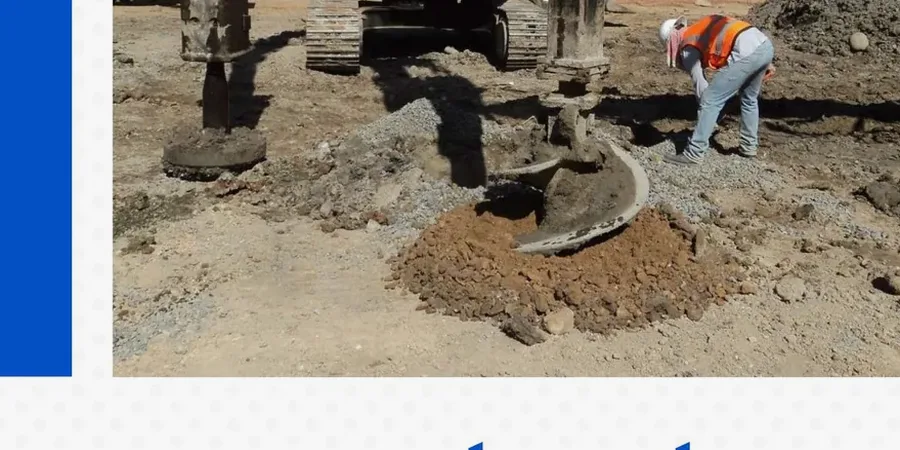
Bangor sits at the edge of the Menai Strait, where the low-lying coastal zone often masks a difficult subsurface of soft estuarine alluvium and glacially disturbed silts extending to depths of 8 to 15 metres. For developers working near the old pier or around the Parc Menai business estate, traditional shallow footings rarely meet the required bearing pressures without excessive settlement. Stone column design provides a controlled solution: we install compacted granular columns through the weak layer, transferring structural loads to more competent strata while simultaneously accelerating consolidation. This approach suits Bangor’s geology particularly well, as the glacial till beneath the alluvium offers a solid bearing layer once reinforced. For sites where the clay fraction is higher, we often combine the stone column layout with in-situ permeability testing to confirm that radial drainage will function within the required timeframe for the project schedule.
In Bangor's estuarine clays, a well-designed stone column grid can reduce total settlement by 60 to 80 percent compared to untreated ground, all without the cost of deep piling.
Regional considerations
The rig we mobilise for Bangor projects is a crawler-mounted bottom-feed vibroflot, typically a 130 kW power pack driving a 300 mm diameter poker with integrated stone delivery. On the narrow access roads near the High Street or behind the university buildings, manoeuvring this equipment demands a pre-construction survey with traffic management planning. The biggest risk in Bangor is encountering buried quay structures or old sea defences within the first three metres: the poker can deviate or jam against timber cribwork or masonry, damaging the tool and delaying the programme. We mitigate this by reviewing historical Ordnance Survey sheets from 1889 and 1913, which often show the original shoreline before the city expanded. A second risk is excessive pore pressure build-up during installation in the low-permeability silts, which can temporarily soften the surrounding ground; we control this with staged installation sequences and standpipe piezometers monitored daily. Overlooking a proper stone column design leads to differential settlement at the slab-on-grade level, cracking partition walls and service connections within the first two years of occupation.
Q&A
What is the typical cost for a stone column design in Bangor?
For a site in the Bangor area, a full design package including settlement analysis and construction drawings ranges from £1,260 to £3,660, depending on the complexity of the ground profile and the number of column groups required.
How does stone column design differ from piling for soft ground?
Stone columns improve the ground mass as a whole by forming a composite block of stone and soil, whereas piles bypass the weak layer entirely. In Bangor's glacial geology, stone columns are often the more economical choice when the weak alluvium is less than 16 metres deep and the structure loads are moderate.
What site investigation data do you need before starting the design?
We require borehole logs with SPT N-values or CPT cone resistance curves, laboratory classification and undrained shear strength data, and groundwater monitoring records. For Bangor sites near the Menai Strait, tidal fluctuation data is essential.
Can stone columns be installed close to existing buildings in Bangor?
Yes, with careful sequencing and vibration monitoring. The bottom-feed dry method generates less lateral displacement than wet top-feed, making it suitable for sites within 3 to 5 metres of existing structures, provided we install piezometers and vibration monitors beforehand.
What is the design life of a stone column foundation?
We design stone column schemes for a 50-year service life as standard for commercial and residential projects, and 100 years for highway or infrastructure works, in accordance with BS EN 1990 and the project-specific brief.