← Home · Laboratory

Grain Size Analysis (Sieve + Hydrometer) in Bangor

Together, we solve the challenges of tomorrow.

READ MORE →

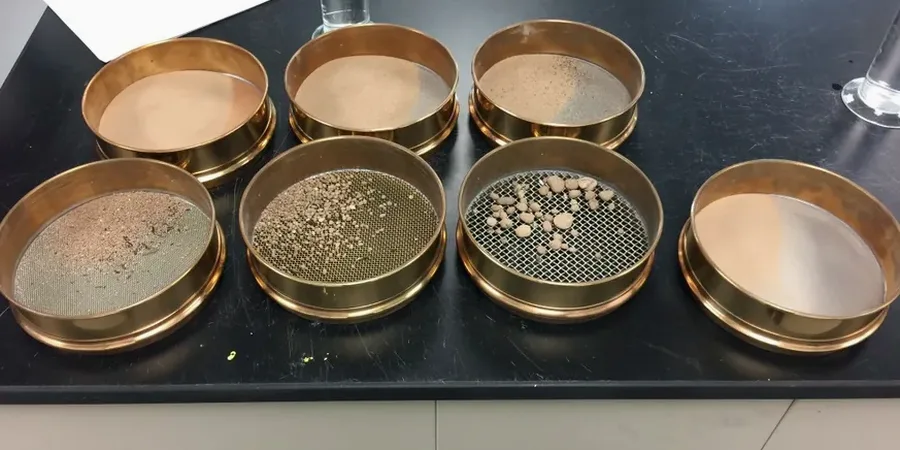
In Bangor, we often see contractors caught out by the glacial till that blankets the hillsides. You excavate expecting competent material and hit a silty, sand-rich layer that completely changes the drainage profile. Nobody wants to re-design a footing mid-project. Our grain size analysis service gives you the full particle distribution curve—from coarse gravel down to clay fines—so your earthworks specification matches what is actually in the ground. We run the full combined procedure: mechanical sieve stack for the coarse fraction and a hydrometer test per BS 5930 for the silt and clay passing the 63-micron sieve. The output is a single, clear report that your structural engineer can use immediately. For projects near the Menai Strait where groundwater interacts with glacial deposits, pairing this with an in-situ permeability test often saves weeks of back-and-forth on drainage design.

A combined sieve and hydrometer test reveals whether your site-won fill will compact predictably—or whether gap grading will cause density problems later.
Method and coverage

Bangor’s development from a Victorian slate-exporting port to a modern university city leaves a legacy of mixed fill across sites on the lower slopes toward Hirael and Upper Bangor. Natural ground here is predominantly glacial till derived from Ordovician shales and grits, often with a bimodal grain size distribution that does not fit textbook assumptions. A standard Proctor alone does not tell you whether that fill will compact evenly. Our combined sieve and hydrometer grain size analysis quantifies exactly that gap—the percentage of intermediate sizes missing in a gap-graded material. The data feeds directly into earthworks specifications, filter design for retaining structures, and frost susceptibility assessments. When the till contains lenses of laminated silt, the hydrometer data becomes critical for assessing liquefaction potential under dynamic loading. Understanding the full grading curve also supports decisions on whether imported granular fill is needed or whether site-won material can be re-used after processing. For pavement design, we often recommend coupling grain size analysis with a CBR test to link soil gradation directly to subgrade strength and pavement thickness.
Grain Size Analysis (Sieve + Hydrometer) in Bangor
Technical reference image — Bangor

Regional considerations

Sites in the Hirael area, close to the shore, often sit on soft estuarine silts with very high fines content—sometimes over 60% passing the 63-micron sieve. A few hundred metres uphill around College Road, the till is much coarser, with abundant gravel and cobbles. If you assume one condition and get the other, the consequences cascade: under-designed drainage, unexpected settlement, or fill that cannot be compacted to specification. Skipping the hydrometer analysis when fines are present leaves you blind to the true clay fraction, which controls permeability and long-term volume change. Our grain size analysis eliminates that guesswork. We report the full curve with Cu and Cc coefficients, so you can classify the material correctly and make confident decisions about re-use versus disposal, filter compatibility, and groundwater control. In a city where ground conditions change within a single postcode, that level of detail is not a luxury—it is basic risk management.

Need a geotechnical assessment?

Reply within 24h.

Email: contact@geotechnical-engineering.biz

Reference parameters


ParameterTypical value
Test standardBS 5930:2015+A1:2020
Sieve range75 mm down to 63 µm
Hydrometer range<63 µm to approx. 0.6 µm
Hydrometer methodSedimentation (BS 1377-2)
Sample mass (coarse)500 g – 5 kg (grading dependent)
Sample mass (fine)50 g dry mass for hydrometer
Dispersing agentSodium hexametaphosphate solution
Reporting parametersD10, D30, D60, Cu, Cc, % gravel/sand/silt/clay

Associated technical services

01

Combined sieve and hydrometer suite

Full particle size distribution from 75 mm down to the clay fraction. Includes wash-sieving, mechanical shaking, and sedimentation analysis.

02

Single-point hydrometer only

For projects where the coarse fraction is already known and only the fines distribution (<63 µm) is needed. Ideal for checking consistency of borrow pit materials.

03

Atterberg limits add-on

Liquid and plastic limit testing on the same sample used for hydrometer analysis. Provides the full classification picture when plasticity is in question.

04

On-site sampling support

Our technicians can visit your site in Bangor to take representative disturbed samples, ensuring the material that reaches the lab reflects actual ground conditions.

Standards that apply


BS 5930:2015+A1:2020 – Code of practice for ground investigations, BS 1377-2:1990 – Methods of test for soils for civil engineering purposes (classification tests), Eurocode 7 (BS EN 1997-1:2004+A1:2013) – Geotechnical design

Q&A

How much does a combined sieve and hydrometer test cost in Bangor?

For a standard combined analysis on a single sample, budget between £90 and £140 depending on the number of sieve sizes requested and whether Atterberg limits are added. We provide a fixed quote before any work starts, with no hidden charges for the hydrometer stage.

What is the minimum sample size needed for a reliable grain size analysis?

For the coarse fraction, we need at least 500 g of material for sands and up to 5 kg for gravelly soils. For the hydrometer portion, about 200 g of the material passing the 2 mm sieve is sufficient to obtain the 50 g dry mass required. Our team can advise on sampling during your site investigation.

How long does the hydrometer test take in the laboratory?

The sedimentation phase alone requires readings over a minimum 24-hour period to capture the full fines distribution down to the clay fraction. Combined with sieve analysis and reporting, the complete turnaround is normally three working days from sample receipt in our Bangor facility.

Location and service area

We serve projects across Bangor and surrounding areas.

View larger map