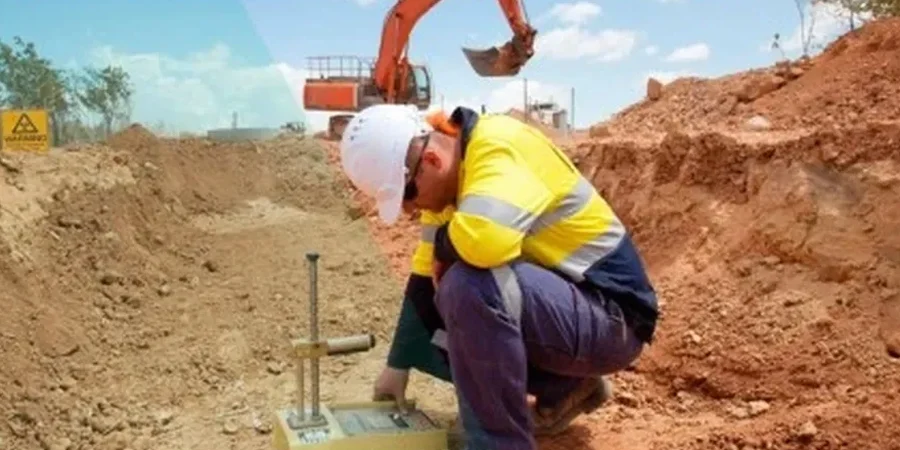
Bangor sits on a geological boundary where Ordovician shales and mudstones meet thick glacial till, and that contrast drives everything we do in seismic microzonation. The Menai Strait isn't just a scenic waterway. It marks a fault-controlled valley, and the soft alluvial deposits along its edges behave very differently under shear waves than the stiffer materials up toward the university hill. You get amplification in places you wouldn't expect. We map those variations block by block. A MASW survey gives us shear-wave velocity profiles down to 30 metres, which feeds directly into site classification per Eurocode 8. Where the till is thin, we often need deeper constraints from seismic refraction to pin the bedrock interface and rule out a velocity inversion that could be missed by surface-wave methods alone.
Two sites separated by a hundred metres in Bangor can shift site class from C to D. That's the difference between a standard design spectrum and a 30 percent increase in base shear.
Method and coverage
The drift geology here averages about 5 to 15 metres of Irish Sea till over bedrock, but pockets in the lower-lying areas near the pier and along the A5 corridor run deeper. We see groundwater within 2 metres in those lower zones, which changes the Vs profile significantly. For microzonation we combine HVSR ambient noise recordings with MASW lines and targeted rotary boreholes. It's not one tool fits all. We cross-check the fundamental site period from HVSR against the Vs30 from MASW. If the two don't reconcile, there's usually a buried channel or a lateral change in the till matrix. We've pulled cores where the till was almost a lodgement diamict with Vs above 400 m/s, then 80 metres away it drops below 250 because of a lens of glaciofluvial sand. BS 5930 guides the logging and the sampling. The microzonation maps end up looking like a patchwork, and that's exactly what they should look like in a glaciated terrain.
Regional considerations
Bangor's population of roughly 18,000 is concentrated on a narrow coastal strip, and the 1984 Llŷn Peninsula earthquake, magnitude 5.4, was felt strongly here despite the epicentre being 40 km away. That event reminded everyone that intraplate seismicity in North Wales is real. The biggest risk we flag in microzonation studies is the two- to three-fold amplification of short-period motion on the soft soils near the waterfront. A site class D profile can turn a 0.10g bedrock motion into 0.25g at the surface. Combine that with older masonry construction common in Upper Bangor, and the vulnerability multiplies. Our maps give the council and developers a defensible basis for applying the correct design spectra, rather than defaulting to the generic Type 2 spectrum and hoping for the best.
Q&A
What does a seismic microzonation study cost in Bangor?
The price depends on the survey area and the number of measurement points required. For a typical site of 1 to 3 hectares in Bangor, the cost ranges from £3,000 for a basic Vs30 screening with a few MASW lines to around £14,950 for a full microzonation including HVSR, refraction, borehole logs, and 1D ground response analysis with GIS deliverables.
How long does the fieldwork take for a microzonation near the Menai Strait?
Fieldwork for a medium-sized site usually takes two to three days. The MASW and HVSR arrays are fast to deploy, but access constraints along the steeper slopes in Upper Bangor can slow things down. We schedule around tides for any work close to the Strait foreshore.
Which Eurocode site class is most common in Bangor?
We see a lot of Class C on the till-covered slopes and Class B where the Ordovician bedrock is shallow, especially around the university campus. Down near the pier and along the coastal flat, Class D appears wherever the alluvial and glaciofluvial deposits exceed about 5 metres. It's not uniform at all, which is why microzonation matters here.
Do I need a microzonation for a single residential extension?
For a single dwelling on a known stiff site, probably not. But if your plot is on the valley floor or within a few hundred metres of the Strait, a targeted Vs30 measurement can confirm whether you're in Class C or D. That one parameter can change the seismic coefficient in your structural design significantly.