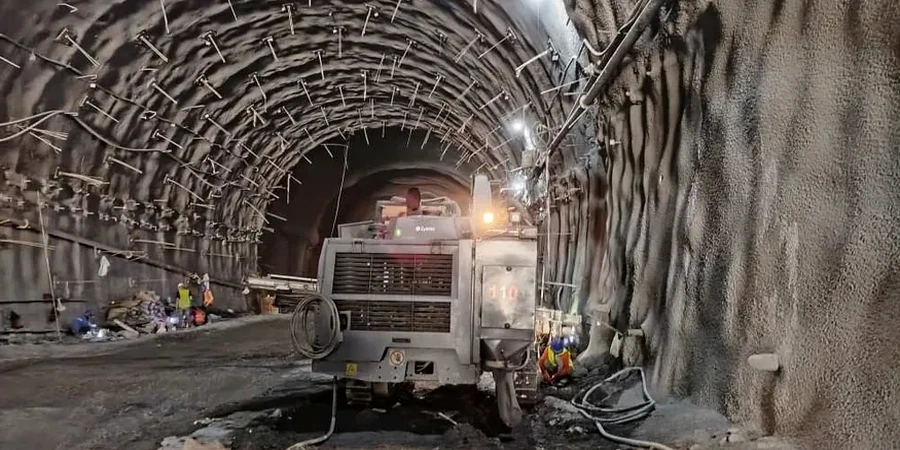
Bangor sits where the Menai Strait meets the foothills of Snowdonia, and that geology shapes every excavation project in the city. Glacial tills drape over Cambrian slate and mudstone, while the water table sits barely three metres below ground level across much of the coastal plain. When a contractor opens a deep dig near Upper Bangor or along the Garth Road corridor, the ground doesn't just sit there passively — it responds to changes in stress, pore pressure, and weather. In our experience, the difference between a smooth job and a costly standstill often comes down to how well the excavation monitoring programme is designed before the first bucket hits the dirt. We run deep excavation instrumentation that captures the full picture: lateral displacement against depth, groundwater fluctuation, and surface settlement, all fed back to the site team within hours of reading. For projects where vibration is a concern — say, next to the Grade I-listed Bangor Cathedral or the university's historic Main Arts building — we pair geotechnical monitoring with seismic refraction surveys to establish baseline ground profiles and confirm that blasting or heavy compaction isn't transferring energy where it shouldn't.
Ground movement in Bangor's glacial till rarely announces itself loudly. It creeps, accelerates after heavy rain, and then catches you on a Friday afternoon if you're not watching the inclinometer plots.
Method and coverage
The kit we deploy across Bangor has to handle Welsh weather: horizontal inclinometer casings that stay readable when the ground is saturated, piezometers that don't freeze in the January cold snaps that hit the Menai shoreline, and total stations set up on stable pillars away from construction traffic. A typical deep excavation job in the city will see us installing vibrating wire piezometers at two or three depths within the glacial till to track how quickly the phreatic surface responds to dewatering. Inclinometer casings go in behind the retaining wall line — often soldier piles driven into slate — and we take baseline readings before the bulk dig starts, then repeat them at intervals tied to excavation stages. Surface settlement points get fixed to kerbs, building foundations, and utility covers within the zone of influence, and we run precise levelling loops back to a deep benchmark outside the affected area. The data lands on the site engineer's phone as a time-series plot, which means decisions about temporary propping or excavation sequencing happen on the same day the movement is detected — not a week later when the report finally arrives.
Regional considerations
Bangor's population of roughly 16,000 doesn't tell the whole story — the city is squeezed between steep slopes and the Strait, which means excavation work happens right next to occupied buildings, busy roads, and Victorian infrastructure that has already seen a century and a half of settlement. The biggest risk we encounter isn't the geology itself, it's the legacy of past construction: backfilled quarries, undocumented service trenches, and old retaining walls that nobody realised were acting as part of the lateral support system. When dewatering pulls the pore pressure down, the effective stress in the glacial till jumps, and those old structures start to move in ways that weren't in the original temporary works design. Continuous monitoring gives the site team a running scoreboard. If an inclinometer shows 8 mm of deflection at the mid-height of a cut and the trigger threshold is 10 mm, the engineer knows exactly how much headroom remains before they need to install an extra row of props or reduce the dig depth. That kind of real-time awareness turns what could be a reactive scramble into a controlled, planned intervention.
Q&A
How much does geotechnical excavation monitoring cost for a typical Bangor project?
For a single-basement dig with two inclinometer casings, three piezometers, and a settlement array of 15 points, budgets in the Bangor area generally fall between £640 and £2,090, depending on monitoring duration, reading frequency, and how quickly the data needs to be turned around. A six-week programme with twice-weekly readings sits at the lower end; daily monitoring with same-day reporting across a four-month deep excavation pushes toward the upper figure.
What's the most common trigger for movement in Bangor's ground conditions?
Heavy or sustained rainfall is the number one driver. The glacial till that blankets much of Bangor has a significant silt fraction, and when it saturates, pore pressures rise quickly. If dewatering hasn't kept pace, the effective stress drops and the excavation face can start to creep — that's why we keep a close eye on the Met Office forecast and increase reading frequency ahead of named storms.
How quickly can you mobilise monitoring equipment to a site in Bangor?
For emergency situations — a retaining wall showing unexpected cracking, or a neighbouring property reporting new settlement — we can have a crew on site within 24 to 48 hours, assuming access is available. Routine programme starts are typically scheduled with one to two weeks' lead time so we can review the temporary works design, agree trigger values, and source any specialist brackets or brackets for listed structures.
Do you need access to neighbouring properties for settlement monitoring?
Ideally, yes. We install monitoring prisms or levelling studs on adjacent buildings with the owner's permission, which gives the most direct measurement of how the excavation is affecting those structures. When access is denied — and it does happen, especially with absentee landlords near the university area — we can set up surface points in the footpath or roadway outside the property and extrapolate, though the uncertainty band widens slightly.