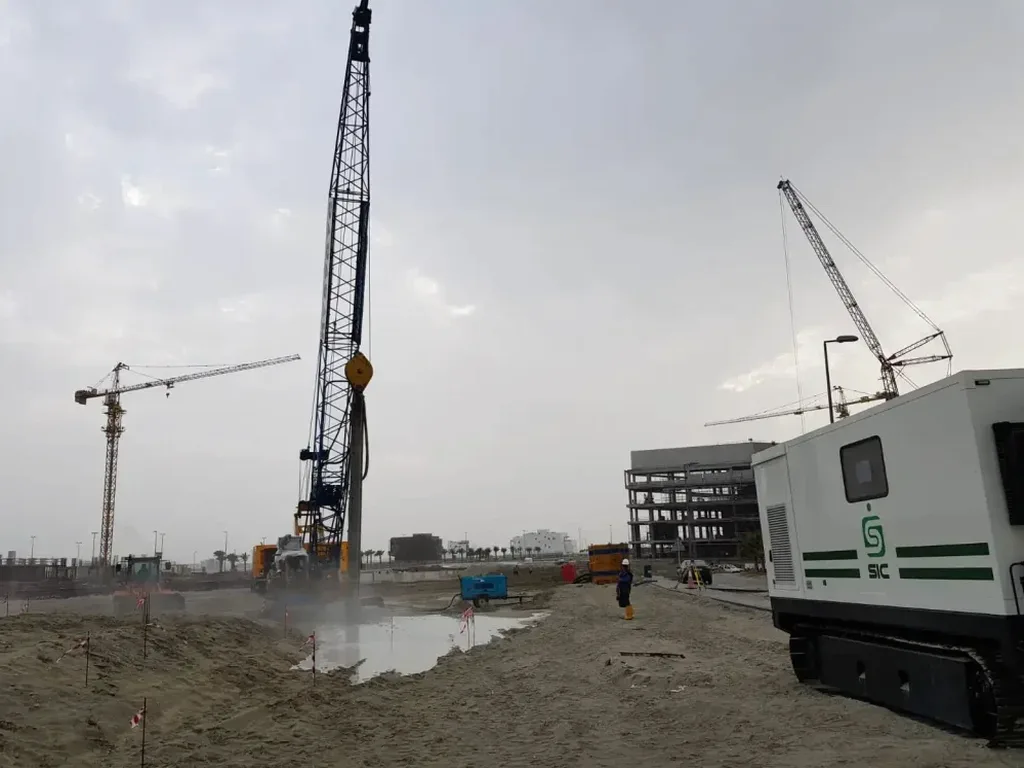
The single most expensive oversight on Bangor construction sites is assuming all granular fill is already compact. It is not. Glacial till and fluvioglacial deposits across the Menai Strait area frequently contain loose lenses that compact unevenly under load. A standard plate test misses what lies two metres down. We design vibrocompaction programmes that target these hidden pockets before foundations are poured. The technique uses a depth vibrator to rearrange soil particles into a denser state, verified through pre- and post-treatment cone penetration testing. In Bangor, where the topography rises sharply from sea level to 100 metres within city limits, variable ground conditions demand more than a desk study. BS EN 14731 specifies design parameters for depth vibrators. Our engineers calibrate grid spacing, vibration frequency, and dwell time to the actual grain-size curve of your site material. We also cross-check results with grain-size analysis to confirm the soil is within the treatable range.
Loose granular soils in Bangor reach refusal when ammeter draw stabilizes—we log that point and move to the next probe.
Q&A
What types of soil in Bangor are suitable for vibrocompaction?
Vibrocompaction works on granular soils with less than 15 percent fines passing the 63-micron sieve. Bangor has extensive deposits of fluvioglacial sands and gravels that respond well. Cohesive soils like glacial till with high clay content are not treatable by vibration alone; they require stone columns instead. We always run a grain-size analysis before committing to the method.
How do you verify the treatment has worked?
We carry out post-treatment SPT or CPT testing at centroid positions between vibrator probes. The acceptance criterion is typically an N60 value above 20 in sands, or a relative density exceeding 70 percent. We deliver a comparative report showing pre- and post-treatment ground profiles with clear pass/fail marking against the design specification.
What does vibrocompaction design cost for a typical Bangor site?
Design fees for a vibrocompaction programme in the Bangor area range from £1,270 to £4,110, depending on site size, number of treatment points, and verification testing requirements. This covers ground investigation interpretation, grid design, field supervision, and the final verification report for building control.
Can vibrocompaction reduce liquefaction risk in Bangor?
Yes. Loose saturated sands are susceptible to liquefaction during seismic events. Vibrocompaction increases relative density above the critical threshold, typically 70 percent, which greatly reduces pore pressure build-up under cyclic loading. For sites near the Menai Strait with high water tables, we design treatment depths that cover the full liquefiable layer identified in the ground investigation.