← Home · Slopes & Walls

Retaining Wall Design in Bangor: Ground Conditions That Shape the Solution

Together, we solve the challenges of tomorrow.

READ MORE →

The most common mistake we see in Bangor is treating the glacial till as uniform. It is not. A contractor excavates for a garden wall, hits a lens of soft clay, and the design assumptions collapse. Bangor's geology is a legacy of ice sheets that left behind a chaotic mix of stiff boulder clay, sands, and gravels. You cannot copy a retaining wall design from the lowlands and expect it to hold here. Our approach starts with the ground. We combine test pits to expose the strata directly with in-situ permeability tests to understand drainage. A retaining wall in Bangor fails more often from water pressure than from earth pressure. That is what the textbook does not tell you. We design to BS EN 1997 (Eurocode 7), but we ground every calculation in site-specific data. No assumptions. Just what the ground gives us.

In Bangor, water pressure behind the wall is the primary design load, not the soil itself. If your drainage detail is wrong, nothing else matters.

Method and coverage

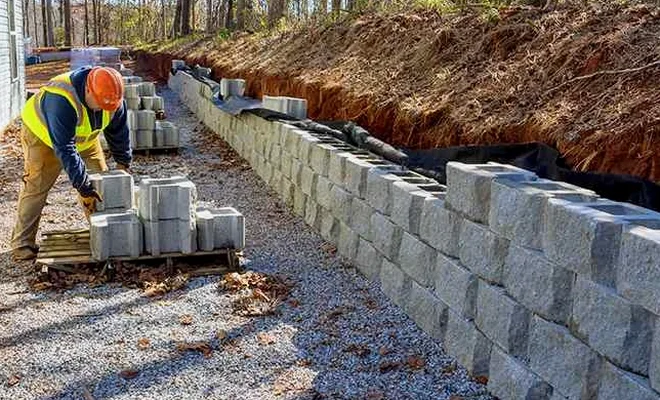
Bangor sits between the Menai Strait and the Snowdonia foothills. The humidity is relentless. Annual rainfall exceeds 1,100 mm. This moisture regime dominates retaining wall design. Free-draining backfill is not optional here. It is survival. We specify granular fill with a minimum permeability of 1×10⁻⁴ m/s, wrapped in geotextile, and we verify it with grain-size analysis. The glacial till itself can be surprisingly impermeable. We have measured values below 1×10⁻⁹ m/s in the matrix. That traps water. That builds hydrostatic pressure. That cracks walls. Our designs include weep holes at 1.5 m centres as a minimum, often closer. For walls over 2 m we add a continuous drainage blanket. The CBR test also becomes relevant when the wall supports a roadway above. We check subgrade strength to ensure the wall foundation does not settle differentially under traffic load. Every detail matters when the rain never stops.
Retaining Wall Design in Bangor: Ground Conditions That Shape the Solution
Technical reference image — Bangor

Regional considerations

Bangor has a lot of Victorian terraces with retaining walls at the rear. Many were built without engineering. They lean. They bulge. The owner calls us when the crack reaches 20 mm. What we find is almost always the same: no drainage, organic backfill, and a foundation sitting on weathered till. The risk is not theoretical. A failed wall in Upper Bangor can destabilise the garden above and the lane below. For new walls over 1.2 m we require a formal Design and Checking procedure under Eurocode 7. For walls adjacent to highways we coordinate with Cyngor Gwynedd. The cost of a proper retaining wall design is negligible compared to rebuilding after a failure. We also check for global stability when the wall is part of a larger slope. The slope stability analysis catches failures that a simple wall calculation misses. In Bangor, the slope is often the bigger problem than the wall itself.

Need a geotechnical assessment?

Reply within 24h.

Email: contact@geotechnical-engineering.biz

Reference parameters


ParameterTypical value
Design standardBS EN 1997-1:2004 (Eurocode 7)
Partial factorsDA1 Combination 1 & 2 (UK National Annex)
Backfill permeability≥ 1×10⁻⁴ m/s (free-draining granular)
Weep hole spacing1.2–1.5 m centres, Ø100 mm minimum
Foundation bearing checkUndrained shear strength from in-situ tests
Sliding resistanceInterface friction δ = ⅔ φ' (cast-in-place)
Seismic hazard0.02–0.04 g PGA (low seismicity zone)

Associated technical services

01

Gravity and Cantilever Wall Design

For walls up to 3 m height. We design mass concrete, gabion, and reinforced concrete cantilever walls. Deliverables include stability calculations, drainage details, and construction drawings. Suitable for residential gardens, driveways, and minor highway works.

02

Embedded and Anchored Wall Design

For walls over 3 m or where space is tight. We design sheet pile, secant pile, and anchored walls. Includes bending moment and deflection analysis using limit equilibrium and numerical methods. Required for deep basements and commercial developments in Bangor's constrained urban plots.

Standards that apply


BS EN 1997-1:2004 (Eurocode 7 Geotechnical design), BS 5930:2015+A1:2020 (Code of practice for ground investigations), BS 8002:2015 (Code of practice for earth retaining structures)

Q&A

Do I need planning permission for a retaining wall in Bangor?

It depends on height and location. Walls under 1 m adjacent to a highway or under 2 m elsewhere generally fall under permitted development. However, if your property is in the Bangor Conservation Area or near a listed building, you should check with Cyngor Gwynedd before starting. We can advise on the engineering submission if planning consent is required.

How much does a retaining wall design cost in Bangor?

For a typical residential retaining wall design in Bangor, fees range from £720 to £3,100. The final cost depends on wall height, ground investigation requirements, and whether the wall is near a boundary or highway. A gravity wall design with a single test pit is at the lower end. An embedded wall with soil parameter derivation from lab testing is at the upper end.

What ground investigation do you need before designing a retaining wall?

At minimum, one test pit or borehole per wall, taken to a depth of at least 1.5 times the wall height. We need to identify the founding stratum, check for groundwater, and sample the backfill zone. In Bangor's glacial till, we often recommend two investigation points because the ground can change dramatically over 10 metres.

How long does the design process take?

Once the ground investigation data is in hand, we typically deliver a full retaining wall design package within 10 to 15 working days. This includes stability calculations, drainage specification, and construction-ready drawings. The site investigation itself may take 1–2 weeks, depending on access and weather.
Location and service area

We serve projects across Bangor and surrounding areas.

View larger map