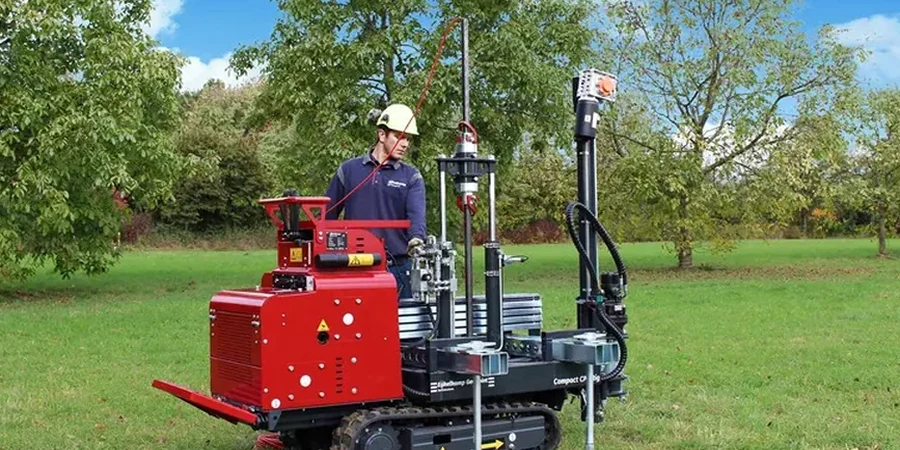
A common mistake on Bangor projects is assuming the ground is uniform enough for a quick, cheap borehole. The Menai Strait’s geological history left a mess of stiff glacial till, pockets of soft alluvium, and weathered Cambrian slate all within a single site. Standard SPTs can miss thin, weak layers that dictate foundation design. Cone Penetration Testing (CPT) gives a continuous vertical profile of tip resistance and sleeve friction, flagging those 100 mm soft seams that would otherwise go undetected. In North Wales, where Sites of Special Scientific Interest and steep topography restrict access, the lightweight rigs we deploy reach awkward corners that a full drilling crew cannot. Combining CPT data with laboratory triaxial testing on recovered samples tightens the ground model, and early slope stability analysis is essential when the profile reveals shear surfaces dipping toward the Menai Strait.
A continuous CPT trace reveals what a dozen SPTs can miss: the exact depth and thickness of the soft silty clay lens that controls settlement.
Q&A
What does a CPT test in Bangor typically cost?
For sites accessible by a tracked CPT rig in the Bangor area, budget between £130 and £200 per sounding metre. The rate depends on total metres, whether dissipation tests are needed, and the anticipated ground conditions: dense glacial till that risks refusal requires a heavier rig and costs toward the upper end.
Can CPT replace boreholes entirely on a Bangor site?
Not entirely. CPT gives continuous geotechnical data but cannot recover samples for visual classification or laboratory testing. The best practice in the varied glacial and alluvial deposits around Bangor is a hybrid approach: CPT for detailed profiling, supplemented by targeted boreholes or trial pits for sampling and index testing.
How do you interpret CPT data in the Cambrian slate bedrock?
In weathered slate, the cone typically records a sharp increase in tip resistance and a drop in friction ratio as it transitions from residual soil to fractured rock. We cross-reference the CPT trace with the British Geological Survey 1:10,000 map for the Bangor area and classify the refusal depth as top of rock when qc exceeds 50 MPa and the friction ratio stabilises below 1%.
What is the difference between a CPT and a dynamic probe?
A dynamic probe (DPSH) records blows per increment and gives only a rough indication of density. A CPT measures tip resistance, sleeve friction, and pore pressure continuously, allowing us to differentiate between a dense sand and a stiff clay – a distinction that is critical in the layered glacial deposits common across Gwynedd.