← Home · Slopes & Walls

Slope Stability Analysis in Bangor: Geotechnical Assessment for Safe Development

Together, we solve the challenges of tomorrow.

READ MORE →

Bangor sits at 53.2277°N on the Menai Strait, where the geology shifts abruptly from Ordovician slate to glacial till and alluvial deposits. A 2023 planning application for a hillside extension near Penrhosgarnedd was refused after the Phase 1 desk study missed a rotational failure plane in weathered mudstone. That scenario plays out more often than it should. Our test pits programme maps the residual soil profile across the site, while triaxial testing yields the effective stress parameters needed for a BS EN 1997-1 Design Approach 1 analysis. For the steep coastal bluffs east of the pier, we integrate seismic refraction to define bedrock geometry before any limit equilibrium modelling begins. The output is a slope stability report that Bangor planning officers and building control surveyors can review without follow-up queries.

A slope stability factor of safety below 1.3 in Bangor's glacial till demands either reinforcement design or a drainage scheme before the planning submission.

Method and coverage

The most frequent mistake we see in Bangor is treating the Penmaenmawr Formation as homogeneous rock. It is not. The upper 2–4 m is typically grade IV–V weathered material with relic joints that open up after heavy rainfall. A slope stability analysis that uses rock-mass parameters from a borehole log alone will overestimate the factor of safety. We run direct shear on undisturbed samples from CPT test locations to capture the true discontinuity-controlled strength. Where the slope toe sits within the tidal zone—common along the Strait—we model rapid drawdown conditions using transient pore-pressure profiles calibrated from piezometer data. The analysis must also account for the 1.2 m of annual rainfall that saturates the silty matrix of the local till. Our laboratory is UKAS-accredited to ISO 17025 for the triaxial and shear-box tests that feed every model. The report includes both drained and undrained scenarios, with sensitivity runs on the water table position.
Slope Stability Analysis in Bangor: Geotechnical Assessment for Safe Development
Technical reference image — Bangor

Regional considerations

A terraced house on Bangor Mountain had its rear garden wall fail in the wet winter of 2020. The owner had built a patio with a 1.8 m cut into the slope without any assessment. Water ponded behind the new retaining feature, the siltstone softened, and a shallow translational slide pushed the wall into the kitchen extension. The repair cost exceeded the original patio budget by a factor of seven. That failure mechanism—loss of suction in overconsolidated glacial material—is entirely predictable with a proper site investigation. We model the pre- and post-construction pore-pressure regime and flag any section where the temporary works condition governs the design. For the steep lanes off Holyhead Road where access limits heavy plant, we specify soil-nailed solutions that can be installed with compact rigs, backed by a stability analysis that the local authority accepts first time.

Need a geotechnical assessment?

Reply within 24h.

Email: contact@geotechnical-engineering.biz

Reference parameters


ParameterTypical value
Analysis methodLimit equilibrium (LEM) with Bishop and Spencer methods
Design standardBS EN 1997-1:2004 + UK National Annex, Design Approach 1
Soil strength inputEffective stress (c', φ') from CIU triaxial or multistage direct shear
Groundwater modelSteady-state seepage with rapid drawdown transient analysis
Seismic coefficient (kh)0.015–0.025 for Bangor (BS EN 1998-5, Type 2 spectrum, agR = 0.02g)
Minimum FoS (persistent)1.25–1.35 dependent on consequence class (CC2 typical)
SoftwareSlide2 / SLOPE/W with verification hand-calc for critical surfaces

Associated technical services

01

Desk Study & Walkover Survey

Review BGS 1:50,000 sheet 106 (Bangor) mapping, aerial LiDAR, and historic landslide records. The walkover logs seepage zones, tension cracks, and vegetation indicators before any intrusive work starts.

02

Limit Equilibrium Modelling

Circular and non-circular analyses using Spencer and Morgenstern–Price methods. We model the fill–natural ground interface explicitly because it controls stability in Bangor's terraced hillside sites.

03

Remedial Design & Monitoring

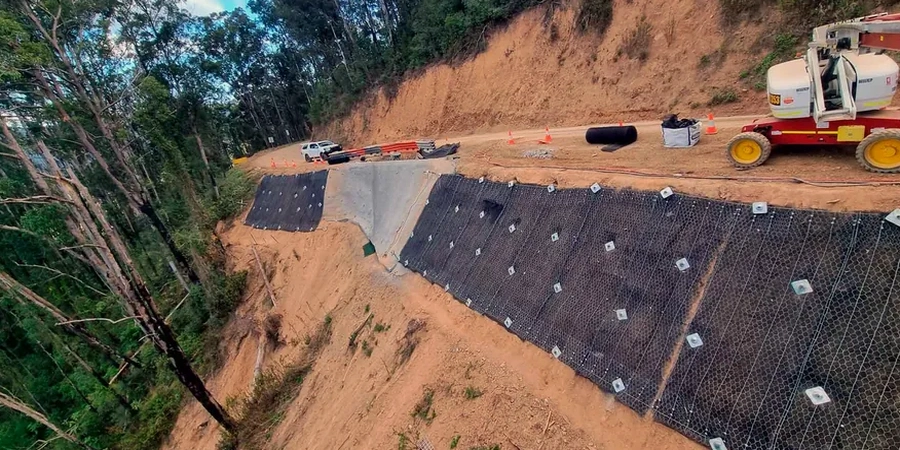
Drainage schemes, soil nails, or reinforced earth for slopes with FoS below the target. Installation supervision and inclinometer monitoring with trigger levels set from the design report.

Standards that apply


BS EN 1997-1:2004 + UK National Annex (Eurocode 7: Geotechnical design), BS 5930:2015 + A1:2020 (Code of practice for ground investigations), BS EN 1998-5:2004 (Eurocode 8: Seismic design – foundations, retaining structures), CIRIA C580 (Embedded retaining walls – guidance for economic design), Highways England CD 622 (Managing geotechnical risk)

Q&A

What is the typical cost range for a slope stability analysis in Bangor?

For a single residential plot in Bangor, the analysis and report typically fall between £1,140 and £3,490 depending on the number of soil units, the groundwater complexity, and whether seismic loading is required. Sites with tidal influence or multiple cross-sections run at the upper end.

How long does a slope stability assessment take from instruction to final report?

The site work—trial pits, CPTs, sampling—takes two to three days. Laboratory testing runs two to three weeks for triaxial effective-stress suites. Modelling, reporting, and QA review add another week. A realistic timeline is four to five weeks.

Does a slope stability report satisfy Bangor building control requirements?

Yes, provided it follows BS EN 1997-1 Design Approach 1 with the UK National Annex. We include the Designers' Risk Assessment and a clear statement of the geotechnical category so building control can sign off without requesting supplementary information.

What soil parameters do you use for Bangor's glacial till?

We derive c' and φ' from consolidated-undrained triaxial tests with pore-pressure measurement on Shelby-tube samples. The till in the Bangor area typically shows c' = 2–8 kPa and φ' = 28–34°, with the lower values corresponding to the weathered matrix-rich facies. These are site-specific and never taken from generic tables.

How do you handle the tidal groundwater along the Menai Strait?

We install standpipe piezometers and log water levels over a full spring–neap tidal cycle. The data feeds a transient seepage model that captures the lag between tide level and pore pressure in the slope. The rapid-drawdown case is run with the lowest low-water spring tide as the downstream boundary.
Location and service area

We serve projects across Bangor and surrounding areas.

View larger map