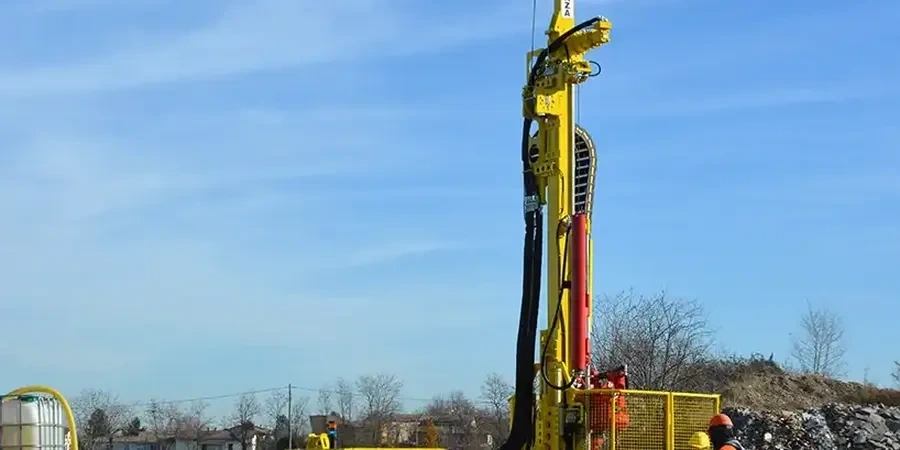
In Bangor, what we most often encounter beneath the topsoil are the complex glacial tills and fluvioglacial deposits left behind by the last ice age across the Menai Strait region. These soils can be highly variable, ranging from stiff boulder clays to loose sands in a matter of metres. A simple boring log rarely tells the full story. The Standard Penetration Test becomes essential here because it gives you a continuous profile of relative density and consistency, correlating the N-value directly with engineering properties. For sites near the university expansion along Deiniol Road or the hillside developments overlooking the pier, combining SPT data with a seismic refraction survey helps map the bedrock depth, which in Bangor can be highly irregular due to the underlying Ordovician shales. This integrated approach avoids surprises during piling or excavation.
A single SPT N-value without geological context is just a number; correlated with the glacial history of North Wales, it becomes a reliable design parameter.
Regional considerations
A recent mixed-use development on a former agricultural plot near the A5 in Bangor encountered a buried channel filled with soft organic silts at 4 metres depth. The initial three boreholes missed it entirely, and the design called for a standard strip footing. Had the investigation relied solely on widely spaced trial pits, the variation in stratigraphy would have gone undetected. By performing closely spaced SPTs, the lens was identified and the foundation design was changed to a deeper piled solution, avoiding differential settlement that would have cracked the superstructure within the first two years. The Menai Strait region is known for these hidden channels and lenses, a legacy of the last glacial retreat. Overlooking a single soft layer can lead to costly litigation and remedial underpinning, which in the constrained streets of Bangor's older quarters becomes a logistical nightmare for any contractor.
Q&A
How much does an SPT investigation cost for a residential project in Bangor?
For a typical residential investigation with a tracked rig and 3–4 boreholes to 10 metres depth, costs generally fall between £450 and £680 per day, depending on access constraints and the number of tests required. A site-specific quotation is always prepared after a brief walkover survey.
How do you correct SPT N-values for the variable glacial soils in the Bangor area?
We apply the standard overburden correction (CN) to obtain N1(60), typically using Liao and Whitman's method. For the dense boulder clays, we also apply a rod length correction and, where energy measurements are taken, normalise to a 60% energy ratio as per BS EN ISO 22476-3. The resulting N60 values are then correlated with drained strength parameters suitable for glacial till.
Can you perform SPT testing on the steep slopes of Upper Bangor?
Yes, we use a compact, low-ground-pressure tracked rig that can operate on slopes up to 30 degrees. Access is always assessed beforehand, and we have a lightweight modular rig for the tightest gardens and rear extensions, which are common in Bangor's hillside terraces.