← Home · Geophysics

Seismic Tomography for Ground Investigation in Bangor

Together, we solve the challenges of tomorrow.

READ MORE →

Bangor’s expansion from a 6th-century monastic settlement into a university city has left an imprint beneath the streets. Victorian terraces climb the steep slopes toward Upper Bangor, while heavier institutional buildings occupy the flatter coastal strip. What connects them is the underlying rockhead, which can plunge unexpectedly beneath glacial till. In our experience, seismic tomography cuts through the guesswork. A refraction survey maps the top of the Bangor blue-grey slate and the overlying drift, giving engineers a continuous velocity profile rather than a single borehole log. When the problem shifts to deeper voids—old mine workings in the Ordovician strata are not uncommon here—reflection tomography helps identify cavities before they find you. For projects near the Menai Strait, where marine clays mask the transition to rock, we combine this with targeted CPT testing to tie seismic velocities to cone resistance, producing a ground model that holds up under Eurocode 7 design requirements.

A velocity contrast of 400 m/s to over 2000 m/s across 20 metres tells you more about a Bangor site than five trial pits ever could.

Method and coverage

The geological contrast between Hirael, down on the coastal mudflats, and the Maesgeirchen estate, perched on glacial deposits, shows why a single investigation method rarely suffices in Bangor. In Hirael, soft estuarine silts barely reach 300 m/s in P-wave velocity, whereas the compact till under Maesgeirchen can exceed 1200 m/s. The tomogram makes that boundary obvious. We process the shot gathers with iterative ray tracing, which handles the lateral velocity variations that simple refraction methods miss. A key output is the 2D velocity cross-section, calibrated against physical sampling. When the bedrock is shallow and rippability matters, we add a seismic refraction line to resolve the top 15 metres with high vertical accuracy. The method works equally well for mapping the buried cliff line that runs roughly parallel to the A5, where rockhead drops by several metres across a short horizontal distance. We pick first arrivals manually on every trace—no automatic picking that blurs the detail you need for foundation design.
Seismic Tomography for Ground Investigation in Bangor
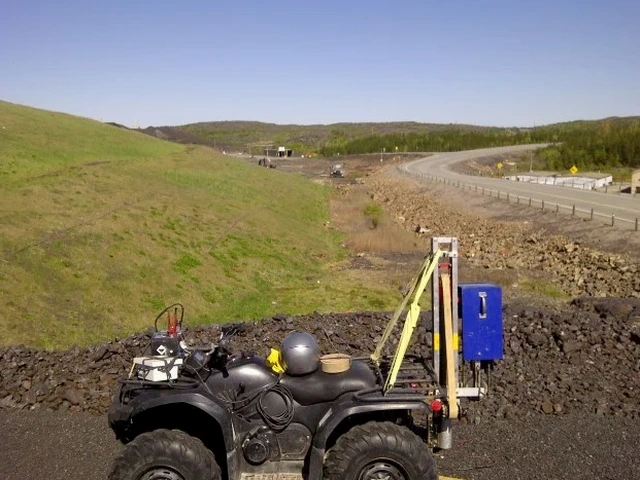
Technical reference image — Bangor

Regional considerations

One thing we keep seeing in Bangor is the false confidence that comes from a refusal at 1.5 metres on a dynamic probe. The till here contains erratic boulders carried down from the Snowdon massif, and a probe refusal on a boulder can look exactly like bedrock on paper. Seismic tomography does not make that mistake. A velocity tomogram reveals the continuous high-velocity layer of true rockhead beneath the scattered point anomalies of boulders. The bigger risk is unmapped mine adits. The slate industry left a legacy of shallow workings, particularly on the southern fringe toward Minffordd. A collapse feature might be days from reaching the surface and invisible from a borehole that misses it by three metres. Reflection tomography, processed with common-midpoint stacking, images the void as a diffraction hyperbola that is hard to misinterpret. Ignoring that signature before placing a retaining wall foundation on a hillside site can turn a routine project into an emergency.

Need a geotechnical assessment?

Reply within 24h.

Email: contact@geotechnical-engineering.biz

Process video


Reference parameters

ParameterTypical value
Survey methodP-wave refraction plus SH-wave reflection
Typical depth of investigation5 m to 120 m below surface
Geophone spacing2 m to 5 m depending on target resolution
Energy sourceAccelerated weight drop or sledgehammer on plate
Data processingIterative ray tracing plus tomographic inversion
Output deliverables2D velocity tomograms, interpreted geologic sections, DXF alignment files
Applicable standardsBS EN 1997-2:2007, BS 5930:2015+A1:2020, BS 1377

Associated technical services


01

P-wave refraction tomography

Primary method for mapping bedrock depth and rippability. Produces a continuous 2D velocity model that highlights the transition from drift to slate-grade rock, calibrated against borehole control where available.

02

SH-wave reflection profiling

Used when the water table saturates the overburden and masks the P-wave refraction signal, or when a higher-resolution image of shallow structure is needed. Effective for detecting mine entries and collapse zones.

03

Cross-hole seismic tomography

Deployed between pairs of boreholes to resolve velocity anomalies at sub-metre scale. Ideal for foundation footprint investigations where a detailed stiffness profile is required for settlement analysis.

04

MASW integration for VS30

Combined with refraction lines to derive shear-wave velocity profiles for seismic site classification to BS EN 1998-1. Particularly relevant for Bangor sites on soft alluvium where site amplification needs quantification.

Standards that apply

BS 5930:2015+A1:2020 — Code of practice for ground investigations, BS EN 1997-2:2007 — Eurocode 7: Geotechnical design, Part 2: Ground investigation and testing, BS 1377 — Standard Guide for Using the Seismic Refraction Method, BS 1377 — Standard Guide for Using the Seismic Reflection Method, CIRIA C812 — Good practice guidance for managing ground conditions

Q&A


How much does a seismic refraction survey cost for a typical Bangor site?

Most single-line refraction surveys in the Bangor area fall between £1,840 and £3,670, depending on line length, number of geophone channels, and access conditions. A 48-channel spread with 2-metre spacing on accessible ground sits at the lower end. Steep, wooded slopes or sites requiring traffic management push costs toward the upper figure. We provide a fixed-price proposal after reviewing the desk study and site photographs—no hidden mobilisation charges for North Wales work.

What depth can seismic tomography reach in Bangor's geological conditions?

Refraction tomography reliably images to about 20–25% of the spread length, so a 100-metre line typically resolves to 20–25 metres depth in the till-over-slate conditions common around Bangor. Reflection tomography, using common-midpoint stacking, can reach beyond 100 metres and is the method of choice for deep mine workings. The actual penetration depends on source energy and background noise; urban sites near the A5 require careful time-of-day scheduling.

Can tomography tell the difference between a boulder and bedrock?

Yes, and this is one of the main reasons we use tomography rather than single-profile refraction in Bangor. A boulder produces a localised velocity high that does not connect laterally. True rockhead appears as a continuous high-velocity horizon across multiple shot gathers. The tomographic inversion process, which iterates toward a minimum-structure model, makes this distinction clearer than any point-test method.

What standards apply to seismic investigation for Eurocode 7 design?

BS EN 1997-2:2007 Part 2 Section 4 covers indirect ground investigation methods including seismic geophysics. We also follow BS 5930:2015+A1:2020 for survey planning and reporting, and BS 1377 for refraction and D7128 for reflection where more detailed procedural guidance is needed. All deliverables include a statement of compliance and a discussion of data quality and limitations.
Location and service area

We serve projects across Bangor and surrounding areas.

View larger map