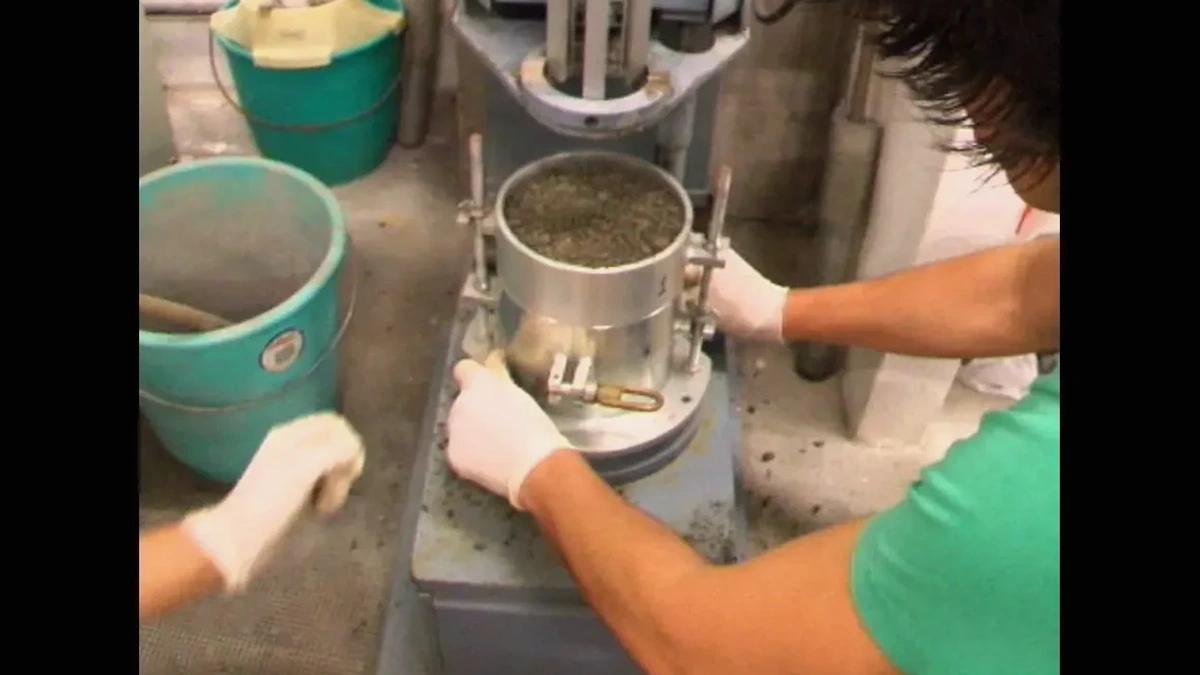
Bangor sits at the coastal edge of Snowdonia, where the geology shifts abruptly from Ordovician slate and gritstone to deep pockets of glacial till and Menai Strait alluvium. These soils react differently to moisture, and a standard compaction assumption can mislead an entire earthworks programme. The Proctor test — both standard and modified — establishes the precise relationship between moisture content and dry density for the material on your site, providing a target that the sand cone density test later verifies in the field. Without this reference curve, density readings are just numbers without context. We run the compaction test on bulk samples taken directly from borrow pits or trench arisings, following the compaction effort that matches your specification: BS 1377-4 for standard Proctor or BS EN 13286-2 for modified effort on road sub-base aggregates. The result is a bespoke compaction target calibrated to the weathered drift that underlies much of Bangor’s urban fringe.
A compaction curve built on local glacial till gives you a density target that actually matches the ground, not a textbook value.
Regional considerations
Bangor experiences over 1000 mm of annual rainfall, and the combination of wet weather with silty glacial tills creates a compaction risk that is easy to underestimate. A Proctor curve built on oven-dried material that never saw site moisture conditions will point to an optimum that cannot be reached in the field during a wet November. The consequence is either under-compaction — leading to settlement under load — or over-rolling that remoulds the soil and traps pore pressure, reducing shear strength. On the A55 corridor projects near Bangor, we have seen fill lifts fail nuclear density acceptance because the laboratory target was established on a summer sample while construction proceeded through winter. The fix is to re-run the Proctor at intervals when borrow source moisture changes, not just once at tender stage. For modified Proctor on crushed-rock sub-base, the risk shifts to particle breakdown during compaction; we check the grading after compaction to ensure the material still meets the specification envelope. A curve that ignores oversize correction can also overstate maximum dry density by 3 to 5 percent, a margin that translates directly into bearing capacity shortfall under a flexible pavement design.
Q&A
How does the Proctor test improve compaction quality on a Bangor site?
It replaces generic density assumptions with a curve specific to your borrow material. On Bangor's glacial tills and alluvial silts, the optimum moisture content can vary by several percentage points between adjacent borrow pits. The test gives the site engineer a measurable target for field density testing, so roller passes and moisture conditioning are adjusted to a number that reflects the actual soil, not a default specification value.
What does Proctor testing cost for a single sample in the Bangor area?
For a standard Proctor test on one bulk sample, prices range from £90 to £180 depending on whether oversize correction, particle size distribution, or multiple moisture points beyond the standard five are required. We quote a firm price after seeing the material description and the specification clause you need to satisfy.
How much material do you need for a Proctor test and how should we sample it?
We need about 25 kg for a standard Proctor and 35 kg for a modified Proctor, sealed in a heavy-duty bag immediately after excavation to preserve natural moisture. Take the sample from the active borrow area, not from the stockpile surface where evaporation changes the water content. If the material contains particles larger than 20 mm, collect extra mass so we can run a parallel grading analysis for oversize correction.